
How to Read a Birth Chart: A Beginner’s Guide
Everything you need to read your own birth chart, step by step: the planets, the signs, the houses and the aspects, with a real sample chart to practice on.

A birth chart is a map of the sky at the exact minute and place you were born. To read it, look at three things: the planets (what), the signs (how) and the houses (where). Then look at the aspects, the angles between the planets, to see how those parts of you work together.
Want to follow along with your own? Get your free birth chart and keep it open as you read.
What a birth chart is
A birth chart, also called a natal chart, is a snapshot of where the Sun, the Moon and the planets were at the moment you were born, as seen from the place you were born. It’s drawn as a wheel. The outer ring holds the twelve zodiac signs, the inner sections are the twelve houses, and the symbols placed around the wheel are the planets. The lines across the middle show the aspects between them.
No two charts are exactly alike. Even twins born a few minutes apart can have different Rising signs and houses. Astrologers read the chart as a portrait of your personality: what drives you, how you love, what you need to feel safe, and where in life your energy goes. It describes the raw material you work with, and what you build from it is up to you.
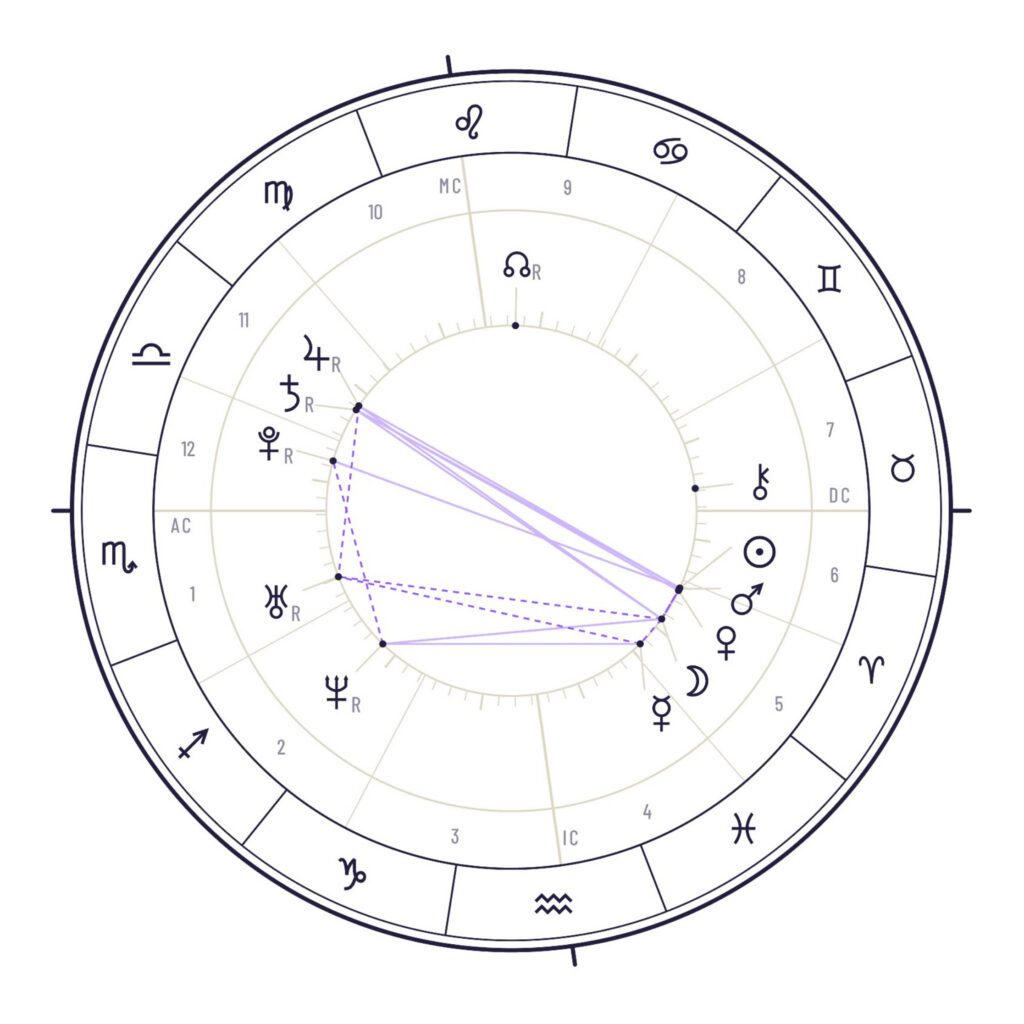
Throughout this guide we’ll use one real example: Charlotte, born on April 3, 1981, at 8:24 PM in New York City. She’s the sample chart from our birth chart reading.
What you need: date, time and place of birth
You need three details to cast an accurate chart.
- Date of birth: this places the Sun and most planets in their signs.
- Time of birth: this sets your Rising sign and your houses. The sky turns a full circle every 24 hours, so the Rising sign changes about every two hours, and the houses move with it. A time that’s off by even 15 minutes can move a planet into a different house.
- Place of birth: the same moment looks different from New York and from London, so the place fixes the angles of the chart.
The best source for your time is a birth certificate or hospital record. If yours doesn’t list a time, our guide on how to find out your time of birth walks through the options, from hospital archives to family memories.
Start with your Big Three: Sun, Moon and Rising
Most astrologers begin a reading with three placements, known as the Big Three. Together they give a quick, surprisingly accurate first sketch of a person.
- Sun sign: your core identity, what you’re here to grow into, your basic drive and vitality. This is the sign most people know as “their sign.”
- Moon sign: your emotional nature, what you need to feel safe, how you react when something touches you deeply.
- Rising sign (Ascendant): the sign rising on the eastern horizon at your birth. It shows your first impression, how you approach new situations, and it sets the starting point for all twelve houses.
Charlotte’s Big Three: Sun in Aries, Moon in Aries and Scorpio Rising. Aries twice gives her a fast, direct, fiery core: she acts first and feels everything at full volume. Scorpio Rising wraps that fire in a calm, private and intense outer layer. People who meet Charlotte often notice the reserve first and only discover the fire once they know her well.
The planets: the “what”
Each planet stands for one part of you, one kind of energy or need. The first five (Sun to Mars) are the personal planets, and they describe your everyday self. The outer planets move slowly and shape whole generations, so they become personal mainly through the house they sit in and the aspects they make to your personal planets.
- The Sun: identity, purpose, vitality, the self you’re growing into.
- The Moon: emotions, needs, instincts, home and comfort.
- Mercury: how you think, speak, learn and process information.
- Venus: love, attraction, beauty, pleasure, money and what you value.
- Mars: drive, desire, courage, anger and how you go after what you want.
- Jupiter: growth, luck, optimism, generosity and beliefs.
- Saturn: discipline, limits, responsibility, fear and maturity.
- Uranus: change, independence, surprises and where you break the rules.
- Neptune: dreams, intuition, imagination, idealism and confusion.
- Pluto: power, depth, transformation and what lies buried.
You’ll also see the North Node and South Node (together, the Lunar Nodes), Chiron and Lilith on many charts, including ours. They add useful detail, but you can safely leave them for later.
What the small “R” means: an R next to a planet means it was retrograde when you were born. From Earth, it appeared to move backward through the sky. Astrologers read a retrograde planet as turned inward: its energy works more privately, more reflectively, or develops later in life. Retrograde personal planets (Mercury, Venus, Mars) are the ones to notice most. Retrograde outer planets are very common, since they spend months of every year moving backward. You may also see an R beside the North Node; the Nodes move backward almost all the time, so it carries little meaning. In Charlotte’s chart, Jupiter, Saturn, Uranus, Neptune and Pluto are all retrograde, while all five personal planets move forward. Her fast, direct Aries core has nothing holding it back.
The signs: the “how”
If a planet is what part of you is acting, the sign shows how it acts: its style, tone and manner. Venus is always about love, but Venus in Aries loves very differently from Venus in Cancer.
Each sign belongs to one of four elements:
- Fire (Aries, Leo, Sagittarius): action, enthusiasm, courage.
- Earth (Taurus, Virgo, Capricorn): practicality, patience, the physical world.
- Air (Gemini, Libra, Aquarius): ideas, conversation, connection.
- Water (Cancer, Scorpio, Pisces): feeling, intuition, emotional depth.
Each sign also has a mode. Cardinal signs (Aries, Cancer, Libra, Capricorn) start things. Fixed signs (Taurus, Leo, Scorpio, Aquarius) keep things going. Mutable signs (Gemini, Virgo, Sagittarius, Pisces) adapt and change.
In a few words each:
- Aries: bold, direct, quick to act.
- Taurus: steady, sensual, loyal.
- Gemini: curious, quick, talkative.
- Cancer: caring, protective, sensitive.
- Leo: warm, expressive, generous.
- Virgo: precise, helpful, observant.
- Libra: fair, charming, partnership-minded.
- Scorpio: intense, private, deeply loyal.
- Sagittarius: free, honest, searching.
- Capricorn: ambitious, patient, responsible.
- Aquarius: independent, original, future-minded.
- Pisces: dreamy, compassionate, intuitive.
In Charlotte’s chart: her Mercury is in Pisces, so she thinks in images and impressions. She often knows something before she can explain why, and she remembers how a conversation felt more clearly than what was said.
The twelve houses: the “where”
The houses divide the chart into twelve areas of life. They start at the Rising sign, on the left side of the wheel, and run counterclockwise. A planet in a house brings its energy into that part of your life.
- 1st house: you, your body, appearance and first impressions.
- 2nd house: money, possessions, income and self-worth.
- 3rd house: communication, siblings, neighbors, short trips and everyday learning.
- 4th house: home, family, roots and your private life.
- 5th house: romance, creativity, fun, pleasure and children.
- 6th house: daily work, routines, health habits and service.
- 7th house: marriage, close partnerships, business partners and contracts.
- 8th house: shared money, intimacy, debts, inheritance and deep change.
- 9th house: travel, higher education, beliefs, publishing and the wider world.
- 10th house: career, reputation, ambition and public life.
- 11th house: friends, groups, communities, hopes and networks.
- 12th house: rest, solitude, the subconscious, secrets and endings.
Empty houses are completely normal, since there are twelve houses and only ten planets. An empty house still matters: you read it through the sign on its cusp (its starting line) and the planet that rules that sign.
In Charlotte’s chart: five planets sit in her 5th house: the Sun, Moon, Mercury, Venus and Mars. A cluster like this is called a stellium, and it shows where life pulls hardest. For Charlotte, that means romance, creativity, play and self-expression sit at the very center of her life.
Aspects: how the planets talk to each other
Aspects are the angles between planets, measured around the wheel. They show which parts of you work together easily and which ones rub against each other. Each aspect allows a little leeway, called the orb, and the tighter the orb, the stronger the aspect. These are the five main ones:
- Conjunction (0°): two planets sit together and blend, acting as one team.
- Sextile (60°): a friendly link that offers opportunities, if you make use of them.
- Square (90°): friction and pressure that push you to grow.
- Trine (120°): an easy, natural flow, often a talent you take for granted.
- Opposition (180°): a tug-of-war between two sides of you that asks for balance.
In Charlotte’s chart: her Sun and Mars are conjunct within 19 minutes of a degree, one of the tightest aspects a chart can have. Her sense of self and her drive move as one. When she wants something, she simply goes for it.
Putting it together: a worked example
Once you know the parts, reading a placement comes down to one simple formula:
Planet + sign + house = what + how + where.
Let’s read Charlotte’s Venus:
Venus in Aries in the 5th house = how she loves + in a bold, direct style + in romance, fun and creativity.
On its own, that already says a lot: Charlotte falls in love quickly and openly, makes the first move, and needs romance to feel exciting and alive.
Now add the aspects. Venus sits within a degree of both her Sun and her Mars, so love, identity and desire are fused for her. Loving someone feels like an expression of who she is, and she pursues it with real energy. Venus also opposes Saturn in Libra in her 11th house of friends and long-term hopes. That’s the counterweight: a fear of rejection, a slower path to commitment, and a lifelong lesson that lasting love needs patience as well as fire.
Finally, connect it to the Rising sign. Scorpio Rising is ruled by Mars (its traditional ruler), and her Mars sits right beside Venus in the 5th house. So the guarded Scorpio exterior belongs to someone whose whole life is led by the heart.
Put together in one sentence: Charlotte loves fast and openly, puts creativity and play at the center of her life, and spends much of it learning that the thrill and the lasting bond can live together.
To read any chart, use the same order:
- Start with the Big Three.
- Find the ruler of the Rising sign and see where it sits.
- Look for crowded houses.
- Read the tightest aspects, especially those to the Sun, the Moon and the Rising ruler.
- Notice what repeats. When the same theme shows up three times, it’s the heart of the chart.
Why your chart may look different on another site
If you’ve checked your chart on more than one website, you may have noticed differences. Here’s our method, stated plainly: Capriastro birth charts use the tropical zodiac, Placidus houses and the Swiss Ephemeris for planetary positions, with the Mean Node.
The planet positions themselves almost always match across sites, because nearly all astrology software uses the same Swiss Ephemeris. The differences usually come from one of these:
- A different zodiac. Vedic and other sidereal sites use a zodiac that sits about 24 degrees away from the tropical one, so many of your planets fall one sign earlier.
- A different house system. Whole Sign, Equal, Koch and Placidus houses draw the house lines in different places, so a planet near a border can land in a neighboring house.
- Birth time and time zone. A wrong time, or a time zone and daylight saving setting that doesn’t match the place and year of birth, can change your Rising sign and every house.
- Mean or True Node. Sites choose one of two methods for the Lunar Nodes, which can differ by up to about a degree and a half.
- Different orbs. Each site allows different leeway for aspects, so aspect lists vary.
Birth chart FAQ
Can I read my birth chart without a birth time?
Partly. Your Sun sign, the signs of most planets and most aspects stay the same whatever time you were born. Your Rising sign, your houses and sometimes your Moon sign need the time. Our guide on how to find out your time of birth can help you track it down.
What’s the most important part of a birth chart?
Start with the Big Three: your Sun, Moon and Rising signs. Then look at the planet that rules your Rising sign and at any tight aspects to the Sun or Moon. Those few placements describe most of the person.
Is a natal chart the same as a birth chart?
Yes. “Natal chart” and “birth chart” mean exactly the same thing: a map of the sky at the moment and place of your birth. “Natal” simply comes from the Latin word for birth.
What is a Rising sign?
Your Rising sign, or Ascendant, is the zodiac sign that was rising on the eastern horizon at the exact moment you were born. It shapes your first impression and sets the order of your twelve houses.
What is a birth chart reading?
A birth chart reading is an interpretation of your whole chart that brings the planets, signs, houses and aspects together into one story about you. Our personal birth chart reading is about twenty pages, written from your exact chart, for $49.
Your own chart
The best way to learn is with your own chart in front of you. Get your free birth chart, find your Big Three, and try the formula on your Venus first.